Mostrar mensagens com a etiqueta South Korea. Mostrar todas as mensagens

World Mathematical Year 2000


In 1992 the International Mathematical Union designated the year 2000 as World Mathematical Year. Several countries issued special stamps with a mathematical theme, including Monaco (with a variety of mathematical images), Belgium (Stokes’ theorem, Fermat’s last theorem and the Ishango bone), Korea (numerical symbols), Croatia (the ‘Blanusa snark’ from graph theory), Italy (Archimedes’ sphere and cylinder), Luxembourg (the WMY 2000 logo and the Riemann zeta function) and Spain (the geometer Julio Rey Pastor).
 [Belgium 2000; Croatia 2000; Italy 2000; Korea 2000; Luxembourg 2000; Monaco 2000; Spain 2000]

ICM 2014, Seoul, S. Korea


An International Congress was held in Seoul, South Korea, in August 2014. For this Congress the postal authorities issued a set of three stamps, featuring the Pythagorean theorem, Euler’s Königsberg bridges problem and Pascal’s triangle.
[Korea 2014]

Leonhard Euler


Born in Basel, Leonhard Euler (1707–1783) spent most of his working life at the scientific academies of St Petersburg and Berlin. Probably the most prolific mathematician of all time, he contributed to almost every branch of mathematics and the physical sciences, including number theory, differential equations, mechanics, astronomy and optics.
 Euler reformulated the calculus using the idea of a function. He introduced the notations e (= 2.718…), i (= sqrt−1), sum (summation) and f (for a function), and related the exponential and trigonometrical functions by means of the fundamental equation ei fi = cos fi + i sin fi, shown on one of the Swiss stamps. In 1735 he solved the Königsberg bridges problem, which asked whether it is possible to cross each of the seven bridges of the city of Königberg without visiting any bridge twice. In 1750 he discovered his polyhedron formula F + V = E + 2, relating the numbers of vertices, edges and faces of a polyhedron; for the icosahedron on the East German stamp, 20 + 12 = 30 + 2.
[East Germany 1950, 1983; Korea 2014; Russia 1957; Switzerland 1957, 2007]

Blaise Pascal


Blaise Pascal (1623–1662) showed an early interest in mathematics. At the age of 16, he discovered his hexagon theorem about six points on a conic joined in a particular way. He wrote a treatise on binomial coefficients and the triangular pattern of these numbers is now known as Pascal’s triangle.
Pascal also investigated the theory of probability, studied atmospheric pressure (Pascal’s principle in hydrodynamics), and investigated the properties of such curves as the cycloid.  
[France 1944, 1962; Korea 2014; Monaco 1973]

The game of Go - Jogo de Go


The ancient game of Go, formerly ‘wei-chi’ or ‘weiqi’, was created in China at least three thousand years ago, and was introduced to Japan and Korea during the Tang Dynasty (618–907) before eventually finding its way to Europe. It is now usually played on a 19 × 19 board by two players who alternately place black and white stones on the intersections of the squares. The object of the game is to capture one’s opponent’s stones by surrounding them, and thereby to control large areas of the board. Two Go formations, ‘China vogue’ (black) and ‘linked stars’ (white), are depicted on a Chinese stamp, and Choe Un, a seven-year-old competitor in the World Go Championships, appears on the stamp from North Korea.
[China 1986, 1993; Korea 1985; North Korea 1997]

Ancient games


Games have a universal appeal and have been played since earliest times. Many require great skill and ingenuity and have been subjected to much mathematical analysis. Chess and Go are discussed below; here we concentrate on some less familiar games.
Senet is an early form of backgammon and may date back to 3000 BC. A celebrated Egyptian example from 1350 BC was found in the tomb of Tutankhamen. The game was played by two players on a 3 x 10 board with lion-shaped pieces.
Mancala is a count-and-capture board game, played with counters (pebbles or beans) by two players. The board has a number of indentations, generally arranged in two rows, with a larger compartment (the ‘mancala’) at each end. The players place counters into the indentations and move them according to specified rules in order to capture their opponent’s counters. Variations on mancala have appeared in many parts of Africa and Asia. In Indonesia it is known as dakon (or tjongkak), while an early form involving four rows of indentations was played in southern Africa under the name morabaraba.
Baghchal, found in Nepal, is a form of draughts or checkers. It is played on a 5 × 5 board by two players, who move their pieces along the lines and capture their opponent’s pieces by ‘jumping over’ them. Janggi is a Korean form of chess, played by two people on a 9 × 10 board.
[Botswana 1977; Egypt 1965; Indonesia 1954; Korea 1985; Nepal 1974]

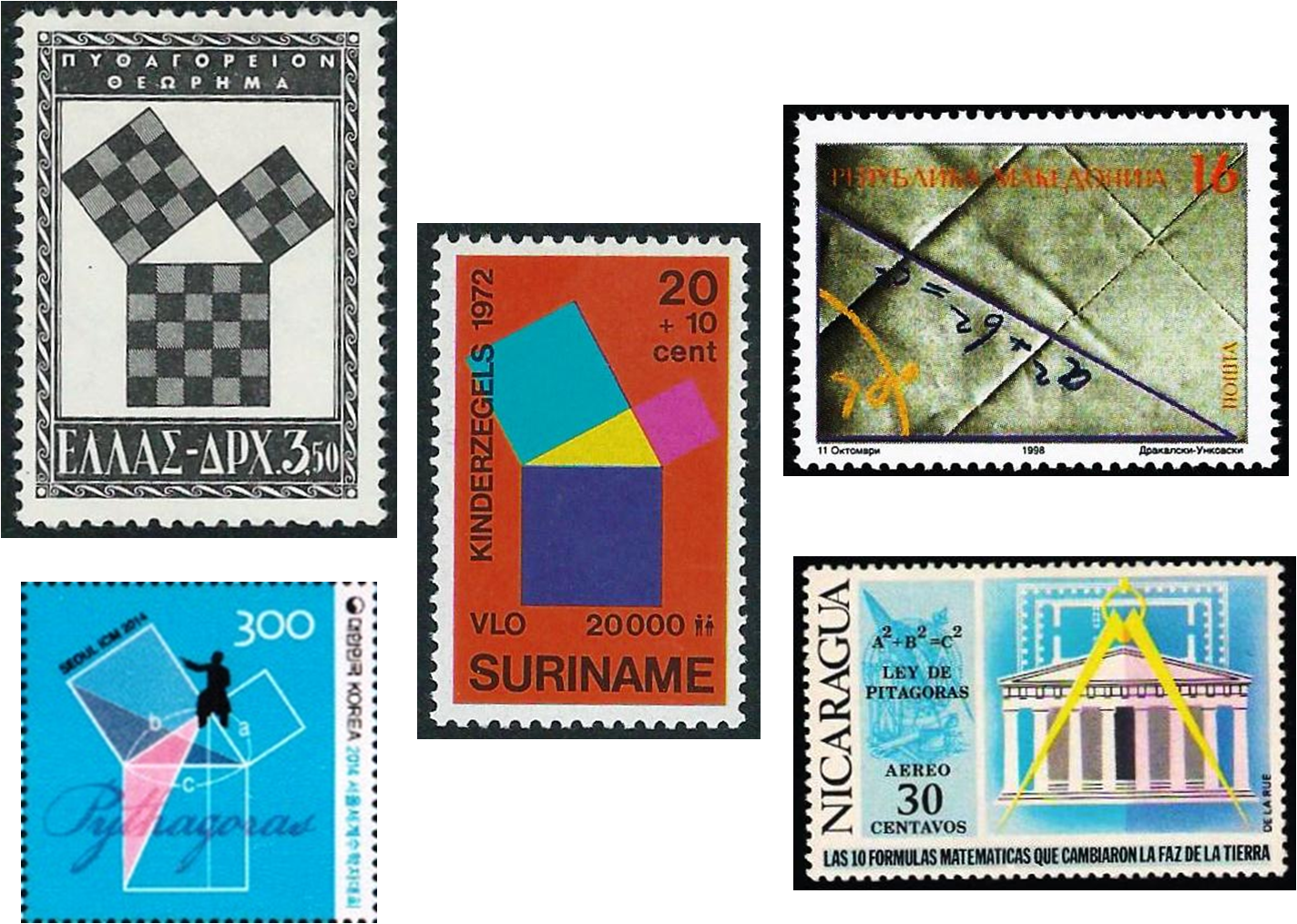
The Pythagorean theorem


It is not known who first proved the Pythagorean theorem, that the area of the square on the hypotenuse of a right-angled triangle is the sum of the areas of the squares on the other two sides, but Pythagorean triples and their connection with right-angled triangles were already known to the Mesopotamians one thousand years earlier.
[Greece 1955; Macedonia 1998; Nicaragua 1971; Korea 2014; Surinam 1972]